
Ten ballots, one premier, one opposition leader, a court ruling, a nine-figure bill — and not a single question that changes anything on its own. Welcome to democracy, Alberta edition.
Picture a retired oilfield welder in an advance-poll line in a church basement somewhere outside Red Deer. A cheerful volunteer hands him ten ballots, for a renovation nobody approved. He flips through them and asks the question every Canadian eventually asks their government: “Which one of these actually does something?”
The honest answer, legally speaking, is none of them. Not on its own. And the one everybody came for — Question 10 — doesn’t even ask whether Alberta should leave Canada. It asks whether the provincial government should begin the legal process required to hold a binding referendum on leaving Canada at some later date. It is a referendum about having a referendum. A permission slip to ask for a permission slip. If you were looking for the Alberta referendum question 10 explained in one sentence, that’s it, and you may now return to your coffee.
Nearly 175,000 Albertans showed up on the first day of advance voting anyway. That tells you something the political class keeps missing: people are not tired of democracy. They’re tired of being handled.
- Albertans vote October 19 on ten questions. All are advisory; none changes the law or the Constitution by itself.
- A citizen petition for an independence vote cleared the signature bar, then a judge quashed its approval in May.
- The government then wrote its own Question 10: stay in Canada, or start the process toward a future binding vote.
- The premier and the opposition leader are both voting “remain” — and both say there will be no second referendum if remain wins.
How a petition became a permission slip
The story of the Alberta independence referendum 2026 starts the way democracy is supposed to work. Under the province’s Citizen Initiative Act, if enough ordinary people sign a petition, the government has to put their question to a vote. The bar was 177,732 signatures. A separatist group called Stay Free Alberta said it collected more than 300,000, and Elections Alberta eventually verified close to 223,000. A rival petition, organized by former deputy premier Thomas Lukaszuk under the “Forever Canadian” banner, was verified at more than 400,000 signatures in favour of staying.
So far, so healthy. Two camps, hundreds of thousands of signatures each, an actual argument happening in public. Then the lawyers arrived.
On May 13, Justice Shaina Leonard of the Court of King’s Bench quashed the chief electoral officer’s approval of the separatist petition, ruling that it had been approved without proper regard for the Crown’s duty to consult First Nations whose treaty rights could be affected by secession. Premier Danielle Smith called the decision anti-democratic and promised an appeal.
Eight days later, in a televised address, she announced a different solution. The government would put its own question on the ballot — one that folded in the Forever Canadian wording and, crucially, would not commit anyone to anything. A “leave” result wouldn’t mandate separation. It would only open the door to another vote, later, under rules still to be written, assuming that vote survived whatever court challenge came next.
Think of it this way: you asked your landlord to fix the furnace. He agreed to hold a tenants’ meeting to discuss whether to form a committee to review whether furnaces are, in principle, desirable. Then he sent you the invoice for the meeting room.
“Albertans asked for a vote. They got a vote on whether to start the process of maybe having one.”
Canada Sorry
The ten-ballot buffet
Question 10 didn’t arrive alone. It joined nine questions the government announced back in February: five on immigration and access to provincially funded programs, and four asking whether Alberta should work with other provinces to amend the Constitution — on who appoints judges, abolishing the Senate, opting out of federal programs without losing the money, and giving provincial laws priority in shared jurisdiction.
Some of those ideas poll well. Some are long overdue conversations. But the constitutional ones need the consent of at least seven provinces, the House of Commons and the Senate — yes, the same Senate one of the questions proposes to abolish. Asking an unelected chamber to vote itself out of existence is a fine piece of prairie humour. Nobody should mistake it for a plan.
| Questions | Topic | What happens after |
|---|---|---|
| 1 – 5 | Immigration and who qualifies for provincially funded programs | Advisory. The government would still need to write and pass legislation. |
| 6 – 9 | Constitutional changes: judges, Senate, federal program opt-outs, provincial law priority | Alberta can only lobby. Amendments need 7 provinces, the Commons and the Senate. |
| 10 | Remain in Canada, or start the legal process toward a future binding separation vote | “Remain”: both main party leaders say the matter is closed. “Process”: a second referendum, someday, subject to federal law and the courts. |
Sources: Elections Alberta; Government of Alberta orders-in-council, 2026.
Strange bedfellows, same bed
Here is the part of Alberta politics that should get more attention than it does. Premier Smith, leader of the United Conservative Party — though looking more liberal these days — has cast her ballot to remain in Canada and is urging Albertans to send Ottawa a message by voting yes on the other nine questions. Opposition NDP Leader Naheed Nenshi, who ran Calgary into the ground with his failed leadership as mayor and calling UCP MLAs as “these monkeys on the other side”, has also voted to remain and is urging Albertans to vote no on the other nine.
They disagree on nearly everything — except the one thing the petitioners actually petitioned about. Both leaders have now said that if remain wins, there will be no second referendum while they’re in charge. Mr. Nenshi went further and called the premier’s version of that same promise a con, which is a bit like two hockey players fighting over who gets to skate the puck out of the zone first.
Meanwhile, the separatist organizers who collected those 223,000 signatures are telling supporters to boycott the other nine questions entirely, calling them a distraction. So the people who started this are skipping most of the ballot, the people who run the province want you to answer most of the ballot, and the people who want to run the province want you to answer it the opposite way. Canada: where cross-party unity appears only when voters threaten to have an idea of their own.
For the record, the polls aren’t close. Canadian polls also receive taxpayer funding and are known sources of liberal government bias. Leger’s October 2–4 survey found 70 per cent of Albertans want to remain, with 22 per cent favouring the separation process and 7 per cent undecided. Which raises the obvious question: if the establishment is that confident, why not ask the clean question the petitioners asked?
Sources: Leger, Ipsos, Angus Reid, Research Co. Online panels; methods and margins vary.
You’re paying for the privilege
The 2023 provincial election cost Albertans about $37 million. This referendum needs an estimated 45 million ballots and roughly 60,000 election workers, and a former chief electoral officer has put the likely price at up to $130 million. The finance minister has pushed back on that figure, and Elections Alberta says the final number depends on the number of questions and voters. Either way, ten ballots per voter is not a budget-friendly format.
Then come the extras: a referendum website, TV spots and promotional videos that together ran past $650,000 by August, plus up to $1.5 million for an economic study on what secession might cost. Taxpayers are funding the vote, the ads explaining the vote, and the study telling them how to feel about the vote. It’s a full-service package. Sorry, no refunds.
We’ve seen this movie before
If this feels familiar, it’s because Canadian voters have been here many times. In 2021, Albertans voted roughly 62 per cent in favour of removing the equalization principle from the Constitution. Equalization carried on exactly as before. The ballot was counted, the result was reported, and the file went wherever files go to retire.
In 1992, the Charlottetown Accord had the support of the prime minister, all ten premiers, every major federal party and most of the country’s business and media establishment. The people voted it down anyway. It remains one of the purest moments in Canadian history: the entire political class on one side, the public on the other, and the public winning.
Ottawa has a longer list. The National Energy Program in 1980 took a hammer to Alberta’s economy and is still remembered in the province like a bad divorce. In 2022, the federal government invoked the Emergencies Act against protesters; a Federal Court judge ruled in 2024 that the invocation was unreasonable. The ArriveCAN app, a glorified customs form, ended up costing an estimated $60 million according to the Auditor General. Each time, the lesson for ordinary Canadians was the same: the people with the power decide when your voice counts, and they usually decide it counts later.
For newcomers: why this is so complicated
“If you’re thinking of moving to Canada, or you just arrived, consider going somewhere else. This whole affair may look baffling, and Canada is in full decline. In most democracies, a referendum asks a question and the answer means something. In Canada, a province can’t simply leave by vote. The Supreme Court ruled in 1998, in its Reference re Secession of Quebec decision, that a clear majority on a clear question would oblige the rest of the country to negotiate — but not to agree. Parliament then passed the Clarity Act, which lets the House of Commons decide whether the question and the majority were clear enough in the first place.
In other words, the referee is also a player, and he owns the rink. That’s not a separatist talking point; it’s simply how the system was built. Add treaty obligations, a Constitution that requires multiple governments to sign off on changes, and courts that can halt a citizen petition before it’s counted, and you get a country where asking a question can take longer than answering it. Nothing works primarily in the interest of citizens, but rather for a handful of politicians who get rich on the backs of taxpayers.
None of this means Canada is a bad place to live. It’s still a safe, semi-decent country — once beautiful and clean, though no longer — full of white people who will apologize to you for anything, especially English Canadians. It does mean newcomers should understand one Canadian habit early: the political class is very comfortable talking about consulting the public and taking your hard-earned money through hefty taxes to squander, and much less comfortable being bound by what the public says.
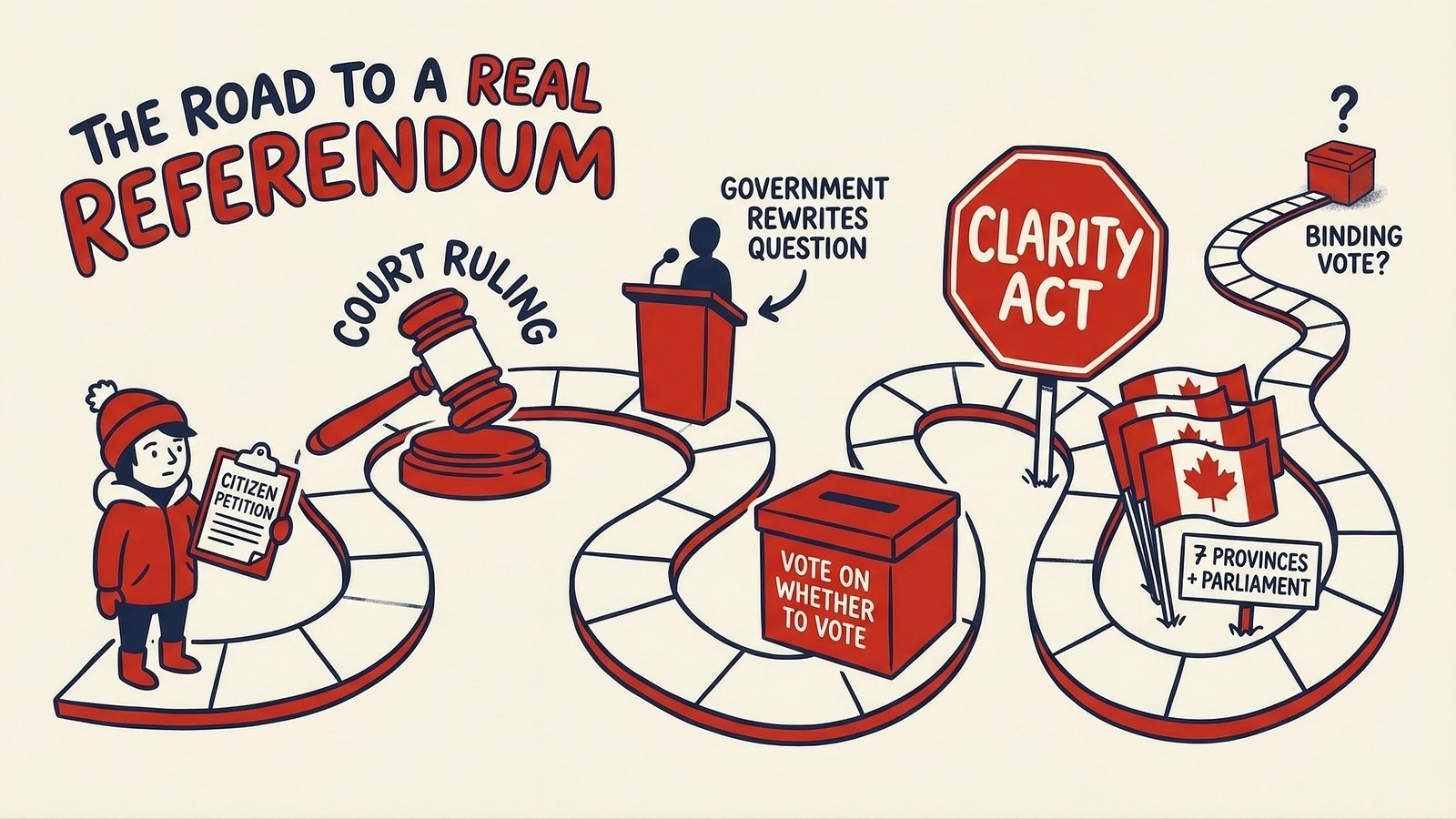
What a real referendum would look like
You don’t have to want Alberta to leave Canada to be annoyed by all this. Most Albertans, by every poll, want to stay. The problem isn’t the answer. It’s the way the question was managed from the moment ordinary citizens tried to ask it themselves.
A confident democracy would do a few simple things. Write citizen-initiated questions in plain language, let the people who gathered the signatures see their own question on the ballot, act on results instead of filing them, and publish the full cost before the vote rather than through access-to-information requests after. None of that is left or right. It’s the basic deal: you pay the bills, you get the say.
On Monday, Albertans will stand in their assigned polling stations, fold ten colourful pieces of paper, and do their civic duty with the patience of people who know exactly what’s being done to them. They’ll probably vote to stay. And then the same politicians who spent a year managing the question will step up to the microphones to thank them for their voice.
The voice was always there. It was the listening that needed a referendum.
- Who can vote: Canadian citizens, 18 or older on October 19, ordinarily resident in Alberta.
- Advance polls: October 13–17 at any advance location.
- Referendum day: Monday, October 19 — vote at your assigned location in your electoral division.
- Results: unofficial within 48 hours of polls closing; official results October 29.
- Check details: Elections Alberta’s official referendum voting information
Albertans once voted on daylight saving time twice — rejecting it in 1967 and approving it in 1971. Even then, it took the province two tries to get a straight answer out of the clock.

